I’ve added battery hold downs to my list of regular checks, because a few days after I flushed the power steering, I pulled into a gas station and did my little ritual:
Pop the hood. Fluids. Belts. Anything leaking? Smoking?
Anything that looks like it is about to become an unplanned story on this site?
That’s when I saw it.
Battery Hold Downs: Fantastic Failures, Shocking Surprises
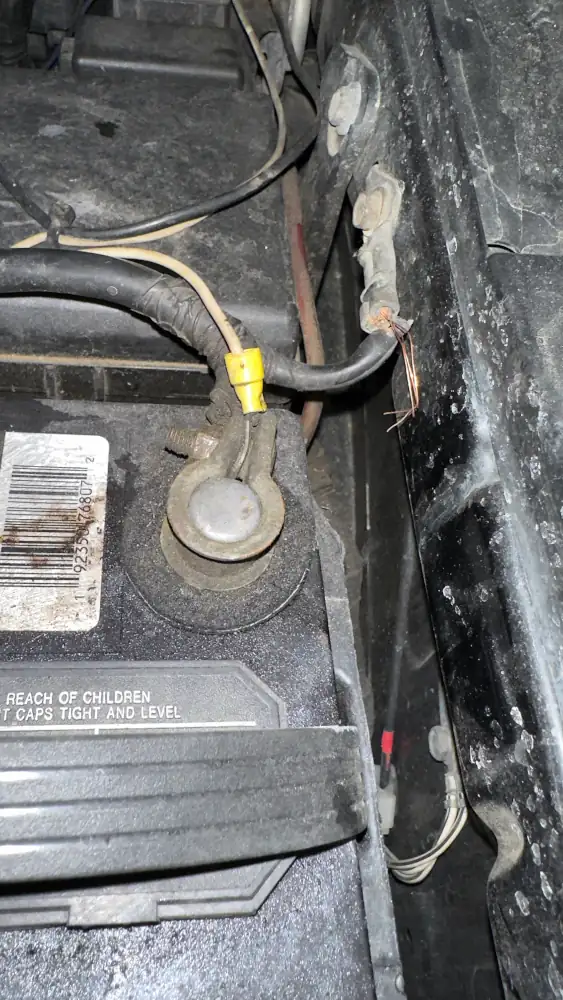
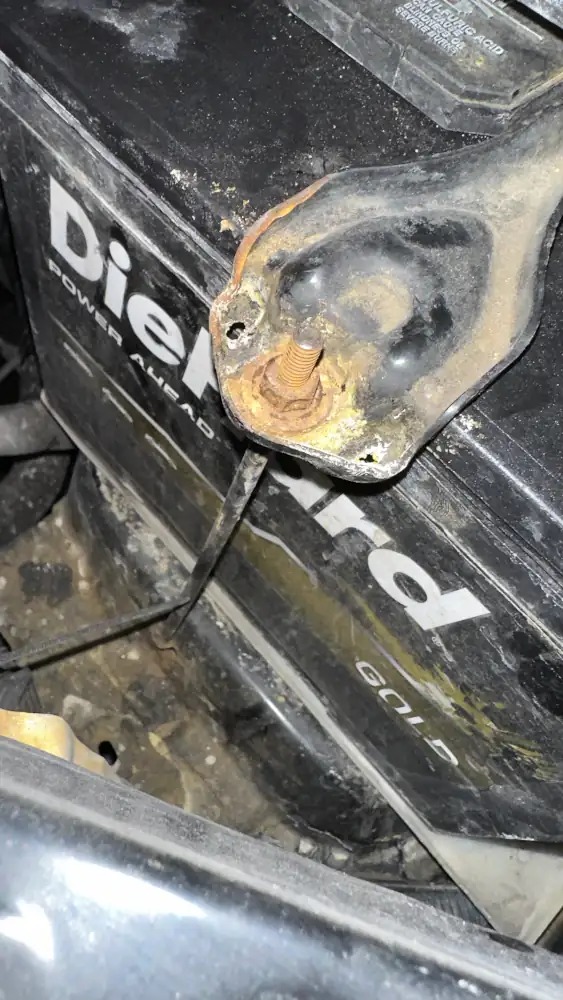
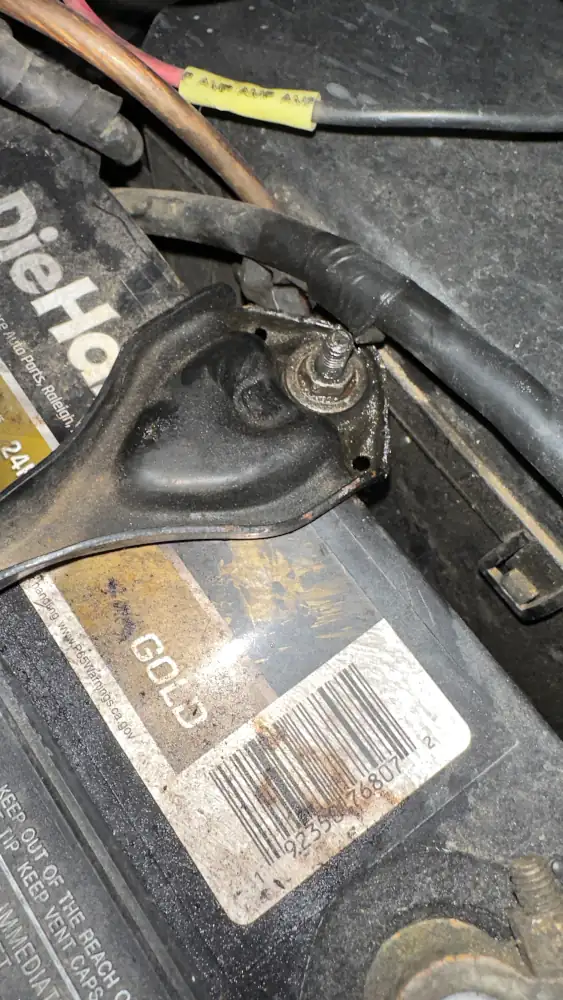
My battery was tipped off its tray. I caught it kissing the radiator. Only the positive and negative cables were keeping it in the engine bay.
Not dramatic enough to strand me. Just… wrong.
I stared at it for a second, doing the mental math of how long it might have been like that. The power steering flush was January 11. This gas stop was January 20. Somewhere in that window, the battery hold downs got loose enough for gravity and my… spirited driving to start writing its own version of the maintenance log.
What broke?
The only obvious casualty was a thick ground wire that ran to the fender. Snapped right at the lug, copper strands splayed like a bad haircut.
Everything else looked intact. No sparks, smoke, or melted insulation. Most surprising of all: No warning lights, weird idle, or glitchy radio.
The Cruiser had been quietly tolerating my neglect.
Here’s the part that’s uncomfortable to admit: I try to be the guy who does maintenance. I carry tools. I write how-to posts because I’m trying to be more intentional in the future.
And I still missed a basic, boring, foundational thing: making sure the battery was actually secured.
A loose battery is not just a nuisance. As you can see, it can tug on cables, damage connections, and in the worst cases, battery movement can create a short circuit that can cause a fire. Especially if the positive terminal ends up contacting something it shouldn’t.
So, yeah, I got lucky.
How I fixed the Battery Hold Downs
I was really fortunate. None of the hardware got scattered. I just grabbed the battery, put it back on its tray, and tightened everything down.
Took some photos, made a plan to repair the ground properly, and then I did the thing I always do after a close call: I replayed it in my head. Not to spiral, but to find the lesson.
I’ve had to learn the hard way that “be perfect next time,” isn’t a lesson. That’s a fantasy.
The real lesson was mindfulness. Not the incense kind. The under-the-hood kind.
Mindfulness is being present to notice the boring stuff before it becomes expensive stuff.
It’s doing the 30-second check because you respect what the machine is doing for you. Toyota used the same designs on FJ as the 4Runner for almost twenty years.
“Old” doesn’t mean “bad.” Sometimes old means:
Forgiving
Reliable
Overbuilt
Old means it will keep running even when you accidentally sabotage it a little. But forgiveness isn’t permission for neglect.
There’s also a quieter, more human angle to this: the world trains us to rush. To skip checks. To treat maintenance as optional until something breaks, and then to blame ourselves for not having more time, more money, more energy.
Just more everything.
I’m trying to do the opposite. Not perfectly. Just consistently.
So if you want the practical takeaway, here it is: Add quiet, thoughtful moments to your routine. Even if it’s 30 seconds of skipped scrolling while you pump.
Mindfulness makes everything better. A quick wiggle on your battery hold downs while you wait for the DinoJuice™ is a smart habit. And it’s the kind of habit that prevents dumb problems from multiplying.
The 60-second battery hold downs check
Grab the battery and try to move it. If it shifts, your battery hold downs aren’t doing their job.
Look at the cables. If the battery moved, the cables took the stress.
Scan for rubbing and pinch points. Vibration plus time equals mystery failures.
Check the battery hold downs hardware. Rust, missing pieces, stripped threads, all of it matters.
Do not “temporary fix” this with bungees. Hold downs exist for a reason.
I didn’t catch this one in my garage. I caught it under fluorescent lights, standing at a pump, heart thudding and blood pressure spiking in public. Which is, honestly, a pretty classic way for lessons to play out.
Anyway, check your battery, stay grounded.
Help the wheels keep rolling, and show your love of affordable adventure with clothing designed by yours truly!
Saturday night, the Cruiser and I took an unplanned break on the shoulder because my registration was expired. Not “I forgot by a week.” Expired-expired. It’s time to get this adventure back on track.
There’s a particular kind of shame that only exists under flashing lights. Sitting in a truck you maintain obsessively, while realizing you did not maintain the paperwork that allows the truck to legally be a truck. Capability is great right up until bureaucracy taps the glass.
Anyway. Hi.
If you’ve noticed a quiet stretch here, you’re not imagining it. I’ve been head-down, trying to get real work done on the video backlog and build a rhythm for the next few months of Adventure Adjacent.
Where I’ve been
The short version: I’ve been making progress, just not the kind that turns into a post, video, or anything public-facing.
I’ve been working, editing, planning, rebuilding my workflow, and doing the unglamorous stuff that makes all the other stuff possible. The upside is the pipeline is real now, not a stack of clips whispering accusations from a hard drive.
The downside is: it looks like I fell off the planet.
Also, I hit the point where streaming felt like dessert when I hadn’t eaten dinner yet. So game streams are paused until Monday, January 26. That’s the line in the sand. If you’re a stream regular, thank you for your patience. If you’re new here, welcome to the part where the sausage is made and occasionally dropped on the floor.
Next steps to Getting Back on Track
The part my brain needs in plain text
Here’s what’s happening next, in the order it needs to happen:
Fishing Creek Revisited: I’m writing the outline for the voiceover script this week, and I’m finally settling on a real title instead of “Fishing Creek Revisited FINAL FINAL v7.”
Alternator swap video: this is next on the editing bench. It’s straightforward, useful, and it deserves to exist as something other than “that folder I keep meaning to open.”
Power steering fluid flush write-up: I did the flush in a rush and didn’t film it, which means it’s getting turned into a proper Field Notes post. Not a how-to masterpiece, but a practical “here’s what I did, here’s what I’d do differently” for anyone else who’s staring at tired fluid and a busy calendar.
And yes, a little post about the registration. That is now on the list too. The reminder is written in all caps in the mental notebook. It’s next to where I keep my hate for bureaucracy and nowhere near the mail about renewal.
Accountability corner: the registration incident
I don’t love sharing that I got pulled over. But I also don’t love the version of adulthood where we pretend we’re all perfectly on top of everything.
I’m building this project around the idea that competence is a form of self-care. For the people riding with us, for the places we visit, for the rigs we depend on. Paperwork counts. Boring counts. The little stuff is the stuff.
So here’s the accountability part: I paid the state their money, while the cop was writing the ticket. I’ve set up recurring reminders so this doesn’t become a yearly tradition. The Cruiser, and my wallet, deserves better.
Side Quest: Mapcase
I’ve also been quietly working on something that looks like adventure software.
It’s early. Like “one working integration and a dream” early.
But the direction is clear: I want a tool that helps you make better calls out there. Weather, road conditions, trail conditions, alerts, the kind of context that keeps a fun drive from turning into a dumb story. When there’s something solid enough to show, I’ll bring you along for the ride.
For now, consider this a breadcrumb: there’s a small map-shaped project growing in the garage.
Back on Track: The weekly rhythm returns
The plan from here is simple: weekly blog posts. Why? The habit makes me show up, and showing up is how any of this becomes real.
If you’ve been here through the quiet stretch, thank you. If you’re also juggling a pile of half-finished things, consider this your friendly reminder that “back on track” usually starts with one unsexy task and a stubborn little decision to keep going.
Next post is one of the items above, no new side quests allowed. If you’re digging yourself out of a backlog too, tell me what you’re up to this week. I’ll cheer from the garage.
Weekday routines dictate that the Cruiser pulls dad duty. Some mornings, when I turn the key and the loose ground wire I still have to track down makes the speakers buzz a certain way, a memory surfaces. I feel the need to hear the songs I listened to when I started driving myself to school.
I didn’t grow up in a scene with glamorous clubs or legendary squats. I grew up with mixtapes, boomboxes, and whatever punk albums I could con out of Columbia House for a penny.
This isn’t a trail report or a stream recap.
This one’s about the soundtrack that shaped how I think about community and about the kind of person I want to be when someone around me stalls or crashes out.
I’m gonna make the subtext so loud it distorts.
What I thought punk was supposed to be
When I was a kid, the media spun punks as teens with a particular fashion sense and drug problems.
Spikes. Leather. Chains. Jackets painted with logos you don’t recognize. Somewhere in there, a safety pin through something that probably shouldn’t have metal through it.
In the grainy square of 80s MTV and letterboxed movies, a punk was the living form of directionless aggression. Their music was forks in a blender set to visuals of sledgehammers smashing the Venus de Milo.
Punk rock became the soundtrack of angry people who like to break things.
That’s not what I found.
Yeah, punk rock sounds like a connecting rod smacking your engine block at 160 beats per minute.
It was built that way on purpose: short, fast, loud. A deliberate rebellion against the overproduced stadium rock of the ‘70s.
Bands in New York and London stripped music down to the studs and played the songs like they were trying to outrun the law.
But under all that volume is something subtle and nuanced: a culture ensconced in mutual aid, individual freedom, and looking out for the people next to you, especially the ones who don’t fit anywhere else.
Nobody told me that part. I had to live it to learn it.
The first time the floor moved
I was probably about five. My sister, who is nine years older, would listen to the Ramones at top volume, morning, noon, and night.
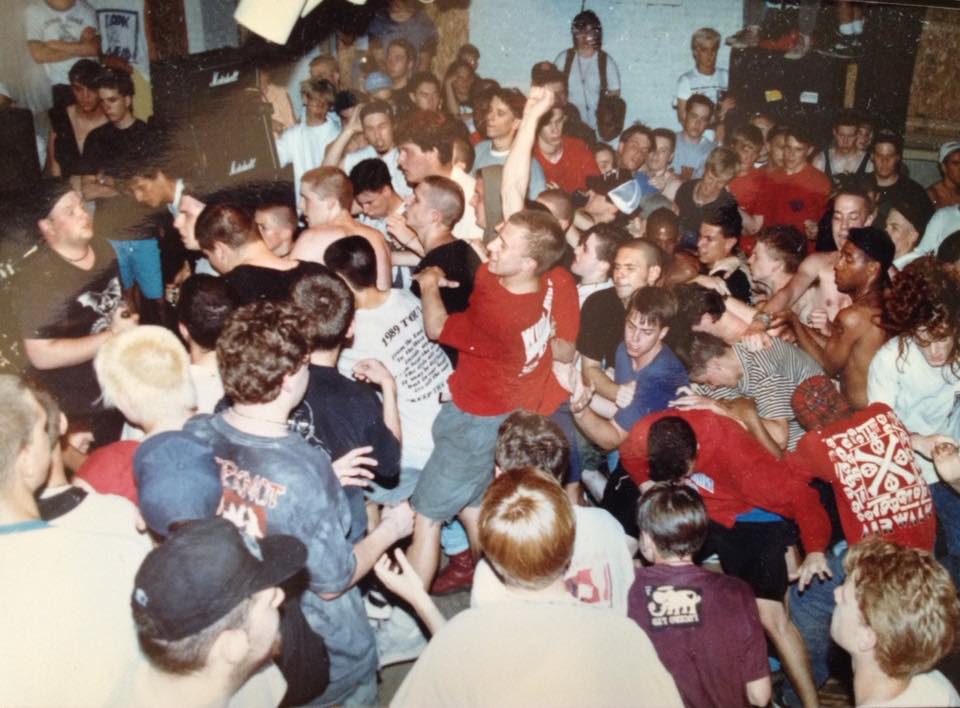
Unisound, Reading PA, late 80s/early 90s. A packed punk show where the main rule of the pit still applies: if someone goes down, you pick them up. Photo courtesy of the “We’re all friends at Unisound” Facebook group. Photo by Anne Spina.
This went on for years. It would be interspersed with other artists, but none stuck with me quite like they did.
Fast forward a few years to the first time I stepped into a real show. I half-expected a riot.
What I got instead was a living diagram of how I wish the world worked.
The music hit and the floor turned into a storm of boots and elbows. People slammed into each other, bounced off, dove back in. From the edge, it looked violent.
From the inside, it felt like organized chaos with one solid rule:
If someone goes down, you pick them up.
That isn’t just folklore.
Ask around and you’ll hear the same thing: in a healthy pit, the main rule is to look out for each other. If someone falls, you get them on their feet. If someone looks scared or hurt, you make space or help them out to the edge.
Never leave people on the ground.
You don’t let creeps use the chaos as cover.
Don’t gatekeep the dance floor.
It’s rowdy, but it’s rowdy on purpose.
That was my first real lesson in aggressive kindness: you can be loud, sweaty, and furious at the world, and still treat the stranger next to you like someone worth protecting.
I didn’t have the right words for it yet, but the message landed.
Punk is for everyone. Full stop.
There’s a line I read years later that finally put words to the feeling: if there’s one core ethos to DIY punk, it’s that punk is for everybody. Anyone can sing, anyone can play, anyone can be part of it.
As an awkward kid who barely limped out of high school, that was huge. I was bored with the schoolwork; didn’t care about grades.
I didn’t think anyone thought like I did.
I definitely didn’t have a five-year plan.
But I did have a summer job that I used the money from to buy a bass guitar and a tiny amp.
It was an old Aria with a tweaked neck and a sunburst pattern. I stuck a middle finger sticker to the back and learned how to read tablature.
I’d memorize how to play my favorite songs and get to know the bands in the process.
Collage of 13 album covers. T-B, L-R: Against the Grain, Bad Religion. Recipe for Hate, Bad Religion. Let’s Go, Rancid. Rocket to Russia, Ramones. Do or Die, Dropkick Murphys. Suffer, Bad Religion. Ramones, Ramones. …And Out Come the Wolves, Rancid. Punk in Drublic, NOFX. Give Me Convenience or Give Me Death, Dead Kennedys. I Heard They Suck Live!!, NOFX. So Long and Thanks for all the Shoes, NOFX. Signed and Sealed in Blood, Dropkick Murphys.
The Bands That Raised Me
The Ramones were proof that you could take three chords, zero subtlety, and a sense of humor and accidentally help kickstart an entire genre.
Rancid took that energy, dragged it through working-class streets and ska basements, and wrote anthems about friends on the edge, union organizers, and cities that chew you up.
Dropkick Murphys made working-class solidarity catchy enough to shout along with. They’ve backed unions, raised money for workers’ rights, and made a point of putting their money where their lyrics are.
Bad Religion was the first band that made me realize punk could come with footnotes. Greg Graffin screaming about science and society on stage, then quietly holding a PhD in zoology and lecturing at UCLA and Cornell, screws with your idea of who gets to be “smart.”
NOFX were the smartass older cousin who showed up with a skateboard, a hangover, and a stack of life lessons hidden under bad jokes. They’ve spent four decades cranking out hooky, melodic hardcore and skate punk, stayed off major labels on purpose, and still somehow became one of the most successful independent punk bands ever. Punk in Drublic turned gold while they were busy telling MTV and the big labels to get lost.
Dead Kennedys were the band that yanked punk’s anger out of the basement and pointed it straight at mayors, presidents, and the whole polished hypocrisy machine. Surf-y riffs, razor-sharp satire, and Jello Biafra’s unhinged sermon-of-a-vocal made songs like “Holiday in Cambodia” and “California Über Alles” feel less like tracks and more like political cartoons set to 200 BPM. They were DIY to the bone, releasing records on their own Alternative Tentacles label and ending up in real-life obscenity trials and censorship battles along the way. That last point quietly taught me that “speak truth to power” isn’t a metaphor: it’s a thing that can actually get you hauled into court, and you do it anyway.
This isn’t even close to an exhaustive list. But all these bands shoved a series of lessons into my skull: being “punk” had less to do with what you wore and more to do with who you showed up for.
Punk is FOR Everyone.
No, I’m not repeating myself.
Black, white, gay, straight, bi, trans, questioning, asexual… whatever. If you were there in good faith, you belonged. If you were trying to harm or control other people, you can go find a curb to chew.
Punk rock isn’t meant to exclude anyone. It’s soft, gooey solidarity wrapped in armor. It hardens you for the realities of the world but cajoles you into still caring about the outcome and the actual human beings.
It explicitly excludes exclusivity.
What does “aggressive kindness” actually mean?
Somewhere along the way, online or in a comment thread, I ran across the phrase “aggressive kindness is very punk,” and it felt like somebody had finally named the thing I’d been feeling for years.
Another person, in a totally different corner of the internet, put it like this: being aggressively kind is way more punk than just being angry all the time.
That’s it. That’s the whole thesis.
It’s a kindness that isn’t soft.
It doesn’t mean “nice” in the way bosses use the word when they want you to shut up about your pay.
Aggressive kindness is:
Calling out the creep in the pit.
Making sure the kid at their first show gets pulled up, not shoved out.
Using your voice to defend someone who’s getting piled on, even when they’re not in the room.
Welcoming the new person at camp, on trail, or in chat like they’re already part of the crew.
It’s hospitality with teeth. Compassion with Doc Martens primed to kick down oppressive systems.
In my head, though, it’s simpler: it’s pit etiquette turned into a golden rule.
Somebody goes down? Pick them up.
If somebody’s getting crushed, make space.
If someone is just trying to exist as themselves and the world is shoving back, you plant your feet and stand in the way.
Oppression is the enemy. Allowing others to live their lives doesn’t harm you.
Buddhism, back roads, and the loud part of compassion
At some point, I started reading Buddhist stuff for the same reason punk clicked: life is suffering, yeah, but what you do with that fact matters.
Compassion, or in Buddhist terms, lovingkindness, shows up there as this patient, quiet thing. Sit with your mind. Breathe. Notice. Don’t make things worse.
Punk taught me the loud version. Make things better.
Both paths are trying to answer the same question: how do you move through a broken world without becoming another sharp edge that cuts people?
There’s a saying: “East Coast people are kind but not nice. West Coast people are nice but not kind.” Growing up an hour outside Philly had its influence on my world view, too.
The second most-famous religious sect in this weird little intersection of Native America and Europe called Pennsylvania was the Quakers. Their plain speech is definitely in the mix of my personal philosophy and might be the most punk thing of all: say true things clearly and live like you mean them.
That’s what I hear in the best punk records. Strip away the distortion and it’s somebody yelling a very old idea:
“These people matter. You matter. We should treat each other like it.”
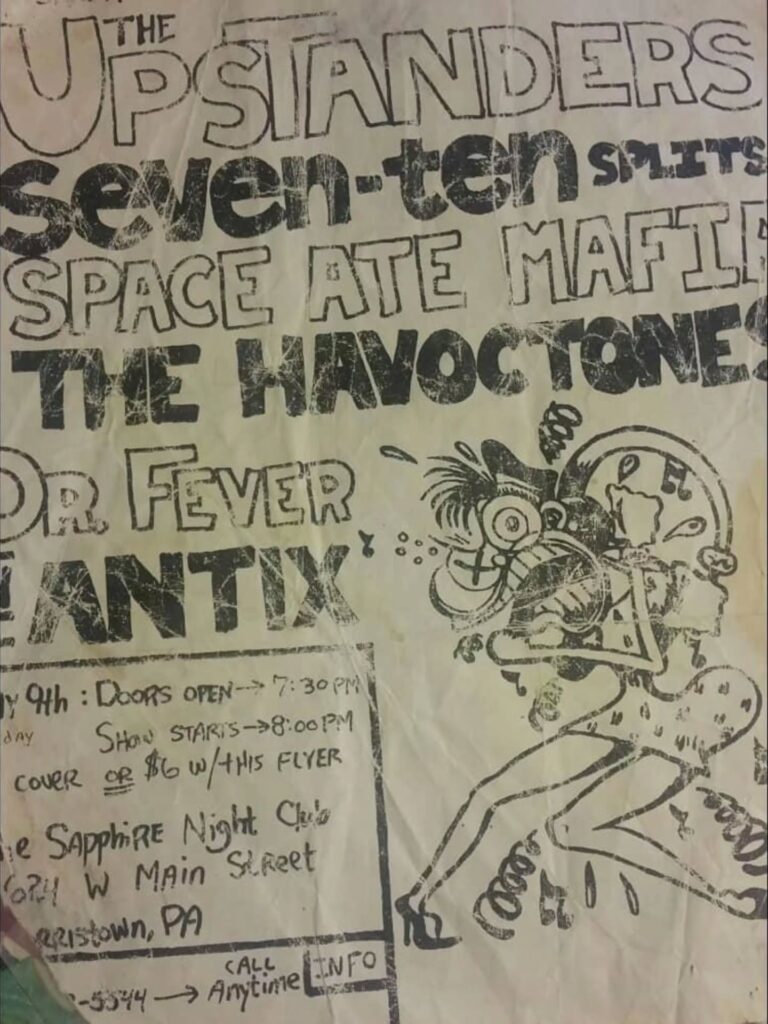
Xerox punk time machine from the Sapphire Night Club in Norristown, PA — The Upstanders, Seven-Ten Splits, Space Ate Mafia, The Havoctones, Dr. Fever, and Antix. My first band, The Real Live Psychics, played our first show in that same room around ’96/’97; a good friend of mine played guitar for Seven-Ten Splits, and the Havoctones were on our bill too. Flyer via @phillyhardcorehistory, art credit @jank322.
How this shows up in Adventure Adjacent
So, what does any of this have to do with my old FJ Cruiser, live streams, and forest roads?
Honestly: everything.
When I pull the FJ off pavement and creep up some rutted forest road, the same ethic applies. These places are shared. The gates and culverts and campsites exist because communities came together, planned them, and built them.
The least I can do is drive in a way that doesn’t make life harder for the next person who comes along. And if I can improve it on the way through, I do it.
Trail etiquette isn’t that different from pit etiquette:
Stay in the lane so you don’t bruise the scenery around you.
Don’t endanger people around you.
If somebody’s in trouble, you stop and help.
Same story with the streams. Most days I’m just a tired guy hauling digital freight, but underneath jokes, questions, and coffee is a simple goal: build a little corner of the internet where people feel safe to be themselves.
That means:
Moderating like a bouncer who loves the dance floor, not like a cop.
Welcoming the quiet lurker, whether or not they say hi.
Respecting boundaries without making it weird.
Shutting down bigotry when it shows up, even if it’s “just a joke.”
Aggressive kindness while streaming looks like “Hey, you’re welcome here” and “Hey, knock that off” occupying the same breath.
It’s the same kind of thing I try to bring to the Field Notes.
When I write about trails, maintenance, or the quiet joy of taking the long way home, there’s always a little subtext whispering: we owe each other more care than this system wants us to give.
The punkest thing I can do at this age
Nobody would catch my old ass if I decided to dive off a stage. My mosh pit is a chat window or a comment section. My uniform is more “tired nerd with a torque wrench” than “studs and liberty spikes.”
But the bands that raised me are still just beneath the tinnitus when I’m tightening lugs on the shoulder for somebody who didn’t plan on learning how to change a tire that day.
They’re there when I’m writing another too-long blog post about some gravel road most people will never be within a hundred miles of.
They’re there when I mute a bigot in chat before they get to ruin somebody else’s night.
Punk taught me that belonging isn’t something you hoard. It’s something you hand out at the door.
So that’s the aim now:
To be the old kid in the back of the room who knows the lyrics, knows where the exits are, and is stubbornly, aggressively kind to anyone who walks in looking for a place to stand.
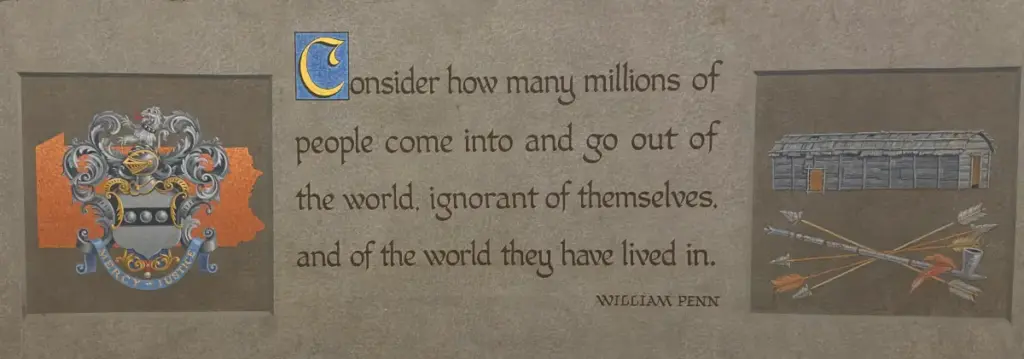
I took this photo at the State Museum of Pennsylvania back in February. It’s William Penn’s words:
“Consider how many millions of people come into and go out of the world, ignorant of themselves, and of the world they have lived in.”
It reads like a friendly nudge: “Hey, don’t miss the good stuff.”
I looked up the quote when I got home and in the very next lines of the same little book, Penn explained we’d never leave a grand palace without noticing the gardens and fountains; so why pass through life without noticing ourselves and our surroundings? (Quod Lib.)
He wasn’t scolding, he was reminding us to pay attention.
This journal entry is my small celebration of that idea.
You don’t need a plane ticket to widen your world. You don’t even need a full tank.
Just change your angle a few degrees and move a little slower.
Expand Your World… by Zooming in?
Years ago, I read a scene in Zen and the Art of Motorcycle Maintenance that I’ve never shaken.
A student is paralyzed by writing a five-hundred-word essay about the whole country.
Her teacher narrows the assignment: don’t start with the country, start with the town, no, the street. No! Start with one building! No, no, no! With a single brick. Better yet, the upper-left brick of the Opera House.
Suddenly the words come. Five thousand of them.
The problem wasn’t lack of content. It was too much distance and an overly broad perspective.
Many of us look at travel the same way. When we try to “see the world,” we freeze up under the weight of the entire globe.
Narrow your view.
Look at one curve of a creek, one street corner, one mossy log.
That’s your upper-left brick.
Hollow Highways vs Unprocessed Pavement
Interstates are marvels of engineering but terrible teachers.
They level the hills, straighten the curves, and pull service plazas over the landscape like fitted sheets (tidy but bland).
Highways are designed to remove friction. But the cookie cutter mile markers, interstate signs, and rest areas homogenize the otherwise unrefined and unprocessed localized scenery that tells you where you actually are and who lives there.
On highways, billboards and exit numbers change, but you don’t.
They shave time off the ETA, but the currency exchanged is exploration for that quick arrival.
Back roads give you rough edges to shape into core memories. A ranch house with a homemade patio. A planter made of old BF Goodrich tires.
Those tell you more about a place than any mile marker.
The color someone paints a door or the way they stack firewood reveals their priorities.
And when the surface turns rough, and we tiptoe in low range, the world swells with detail.
Mushrooms lace a downed maple. A roadside spring burbles out of a stone face. A hawk drops off a telephone pole and toward an open lake, re-emerging with a fish in its talons.
You didn’t know any of this was there, because you’re usually on pavement, half a mile away and pushing the upper bounds of the speed limit.
Moving slowly isn’t just safer for tires and oil pans. It’s training for mindful seeing.
Penn was a Quaker, the founder of Pennsylvania, and he tried to build a place where ordinary people could live with unusual freedoms for the time: religious tolerance, representative government, and a very public experiment in getting along.
He called it a “holy experiment,” and his Frame of Government sketched out ideas that echoed far beyond his colony. (Encyclopedia Britannica)
Quakers prized plain speech, saying things directly, without fancy words.
And they famously used “thee” and “thou” long after those pronouns fell out of everyday English. It was their commitment to treat everyone equally.
That habit of directness and equality shaped the culture that grew here. (Quaker.org)
So, when Penn writes “ignorant,” he isn’t sneering.
In his Fruits of Solitude, the passage continues: “if we’d never tour Windsor Castle without noticing the gardens and fountains, why do so many people pass through life without noticing their own bodies, minds, and the world they’re in?”
It’s a lament for missed wonder.
Expand Your World, on a budget
Booked tickets and stamped passports aren’t a requirement when you can discover the world for less than the cost of lunch.
Pick a square mile you think you know. A park you drive by all the time but haven’t visited, the neighborhood behind your grocery store, wherever. Give yourself an hour to walk it like a tourist. Read every little sign. Try to notice which trees were planted and which came from the magic of nature. Count how many kinds of mailboxes you see.
Ride a bike where you usually drive. The slope you never noticed in a car becomes a hill with personality. The smell of fresh baked bread wafts from the deli you’ve blurred past since 2012.
Trade one route a week for the long way. Stop at the farm stand you always promise you’ll stop at “next time” and ask the person behind the counter what’s growing weirdly well this year.
Go mushroom watching. (Unless you already know mushrooms, don’t eat anything, please.) Collect them with your camera or a notebook. You’ll start to see patterns where each variety lives, on a stump, a fallen log, in disturbed soil, at the foot of oaks.
Borrow the old county atlas from your library and trace one thin gray line that you’ve never taken. Chances are it follows a creek, and creeks are always worth your time.
The trick isn’t distance, it’s attention.
What the FJ keeps teaching me
My FJ is happiest in 35 zones and on forest roads. Slow going rewards you with exactly the small, clear truths Penn and Pirsig pointed toward.
The truck’s whole personality is an argument for patience: choose a line, roll on the throttle, feel the tires communicate.
You can hear different birds with the windows down at five miles an hour than you ever catch at fifty-five.
The biggest thing I’ve realized is:
I didn’t need the truck to make me see the world differently.
The world is there whether I’m in the seat of a Land Rover, Jeep, Toyota, or Schwinn.
The FJ is fun, I plan to keep it around as long as possible, but, in hindsight, I didn’t really need this to get out and go slow.
You might enjoy your purchases, but curiosity outlasts gear.
See More. Get More.
Slow travel pays off in human details too.
Highways connect cities. Back roads connect porches.
If you want to understand how people actually live, pay attention to their small choices around their homes.
When you see a Little Free Library topped with a tin rooster, you’re seeing affection expressed in wood screws and weatherproof paint.
When you find the neighborhood where every stoop has a bucket of sidewalk chalk, you can bet those blocks hum with scooters and laughter after the last school bell.
The more we see of the human condition (the real ways people solve small problems, decorate their homes, and protect their peace) the broader our understanding of people’s everyday realities becomes.
It shows us that the “other side of town” is mostly just “our side of town” with different snacks and, maybe, a better porch swing.
Micro-pilgrimages
I’ve come to think of these little outings as micro-pilgrimages.
It’s not about praying or religion though. They don’t require sacred sites; they require sacred attention.
Drive to the State Museum, stand in front of a quote, bask in it once, twice, a dozen times until it lands.
Walk the same loop you always walk but carry a notebook this time and sketch the shape of one leaf you can’t name.
Visit a historic marker you’ve ignored because it sits in a strange spot next to a tire shop. Then read the details linked to that marker and let the past sit with you for a minute.
Penn’s “holy experiment” didn’t become a museum caption overnight; it was written in real time by friends and strangers arguing about how to live. (Encyclopedia of Greater Philadelphia)
If you want to add a pinch of structure, borrow a tool from Pirsig’s teacher: give yourself one ridiculously narrow prompt each time you go out:
Photograph only mailboxes today.
Write one paragraph about the way water moves on the trail after last night’s rain.
Find three colors of lichen.
Learn about lichen’s role in the local ecosystem
Focusing on the “upper-left brick” has a way of opening the entire wall. (Terebess)
A quick nod to the past that made this present
Penn’s experiment wasn’t perfect. No experiment run by actual humans is.
But the ideas he pressed into the foundation here still matter.
He imagined a place where people of different beliefs could live together, and he built a government that tried, in its imperfect, 17th-century way, to support that.
Those principles of religious tolerance and representative rule influenced the place we live now.
And the way he and his fellow Friends valued plain speech still reads as an amiable challenge: say true things simply, then go act like you mean them.
That, too, is a way of paying attention. (Western Friend)
Tips to Expand Your World
Set a 90-minute timer. Pick one. Do it.
Pick one back road you’ve never taken between two places you already go. Leave ten minutes early. Expect to stop once and just…look.
Visit one small museum within an hour of home. Find a single artifact or plaque that makes you curious, then look up the source later. Primary sources are a rabbit hole worth falling into.
Walk a trail at half-speed. Count how many different plants are growing on a single dead log. You will be astonished.
Talk to one person about the thing they maintain. A garden. A block. A food pantry shelf. Ask what they’ve learned and pay attention to the answer.
None of this requires money, gadgets, or influencer cred.
It requires a willingness to move your eyes and your feet a little differently.
The Happy Conclusion
Penn’s line is an invitation. Most of us won’t circumnavigate anything. And that’s fine. You can expand your world right where you live.
Start with a brick: the corner of a city block, the rough bark of a neighborhood oak, the cinder-block wall behind a diner where a downspout broke and rain has washed the paint thin.
When you slow down, the world shows off. And when you really see, you carry that attention to the next place, and the next conversation, and the next problem that needs a patient human.
I’ll keep taking the long way home. Trips are always more fun with friends. Come along.
Help the wheels keep rolling, and show your love of affordable adventure with clothing designed by yours truly!
Two months, 5,000 worry-free miles, time for the first FJ Cruiser oil change. Warm it up, drop the plug, swap the filter, fresh crush washer; nothing that earns a merit badge.
The only surprises were the honest ones: two torn inner CV boots and the reminder that trucks tell the truth long before the sales brochures.
FJ Cruiser Oil Change: Kneeling at the 5,000 Mile Altar
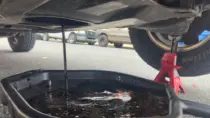
The drain stream looked like strong coffee and the filter surrendered like it had somewhere else to be. Top up with fresh 5W‑30, check for leaks, done.
Somewhere between the drain plug and the dipstick I spotted CV grease flung like confetti.
Add it to the list, but the next few Saturdays are spoken for.
Old trucks are simple that way: feed them boring maintenance and they repay you with more interesting miles than you have any right to.
What oil weight?
Toyota recommends SAE 5W-30 for the 1GR-FE
Five Quarts and a Quiet History Lesson
It’s good yet.
As I lay there on my back, staring at the Cruiser’s underbelly, the grease, oil, and hot engine smells brought me back.
I grew up behind GM parts counters; my dad worked for GM for 20+ years during the now infamous “malaise era.” The Buy American chorus trumpeted from every terrestrial radio station and between every prime-time TV show.
I knew bone deep: trucks with bow-tie emblems were the best.
Later I learned those opinions ship with hidden dealer costs: a tariff with a barnyard nickname pecking at truck choices since the ’60s, “voluntary” limits on car imports from Japan in the ’80s, and ad men who deftly disguised consumerism as patriotism.
None of it is scandal; it’s stagecraft. You’re just part of the planned suburban furniture until you bring a different rig to the show.
The FJ is that different rig. It doesn’t argue. It just starts, shrugs at mileage, and behaves with better manners than man’s best friend… sorry, Hugo.
How much oil do I need for my FJ Cruiser oil change?
Have 6 quarts on the bench; you’ll use about 5.5 quarts with a new filter.
Slogans sell trucks. Loyalty is earned in miles, not marketing.
What the FJ Cruiser Oil Change Actually Told Me
Nope, not good.
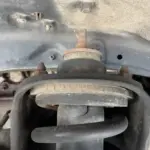
Post‑oil change crawl around: bushings with tasteful crow’s‑feet, hardware where Toyota left it, CV boots officially on the to‑do list.
The message was simple: keep up the mundane maintenance and I’ll handle the adventurous bits. Fair trade.
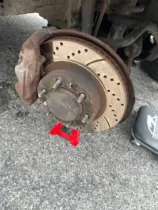
One curiosity from the crawl around: the previous owner fitted drilled and slotted rotors up front. They stop fine, but they’re not my forever plan.
That rant gets its own post; for now, call them temporary tattoos on the front hubs.
From 0-60 to 4-Low
I used to memorize 0-60 times and horsepower numbers. I drooled over Motown metal from the 50’s and 60’s and imagined building my own sleeper project.
These days I prefer the quiet satisfaction of picking a line, letting the truck do its clever little traction trick, and showing up for Monday morning school drop-off like nothing happened.
The FJ excels at that kind of competence. It asks for oil on schedule and patience for aging rubber. In return, reliability becomes a personality trait.
How tight should I make the lugs after rotating the tires?
Toyota recommends 85 ft-lb or 113 N-m
Why Toyota?
No conversion therapy, no celeb-studded ad campaign. Just a machine that rewards attention.
If there’s a moral, it’s this: maintain the truck you have, doubt the stories you inherited, and let experience pick your team. The rest is shop towels, torque specs, and flashing MAINT REQD lights.
Be Part of the Conversation
If you defected from one badge to another, tell me what converted you. Or share what runs through your mind while you’re turning wrenches.
Until next time, I’ll be under the truck plotting a CV reboot and pretending drilled rotors add horsepower.
Spin-on Toyota 99015-YZZD3 [*Affiliate Link] (OE).
Maintenance reminder reset
Odometer showing -> key to ACC/LOCK – hold trip reset -> key to ON while holding -> bars count down to “000000” -> release; light goes off.
Wheel lug nut torque
85 ft-lb (113 N-m) (handy if you rotate tires).
TRD front skid-plate bolts
22 ft-lb (30 N-m) (if you have one of those)
*If you click a link on this page and make a purchase, we may earn a commission. As an Amazon Associate, we earn from qualifying purchases. We only recommend gear we use or trust—never paywalls, never pay-to-say-nice-things.
Step-by-Step
Warm it up. Three to five minutes brings the oil from maple syrup to pour-over. Shut it down.
Open the stage. Drop the little service door or the front skid (Mine doesn’t have the service door) if you want elbow room (re-torque to spec on the way back).
Catch ready. Pan under the plug; crack the 14 mm drain bolt and let it ride. Admire the coffee-dark honesty.
Filter off. Spin the old filter free. If it’s stubborn, clean the base and use a proper cap wrench.
New gasket, not new muscles. Oil the new filter’s gasket, spin on hand-tight plus ¾ turn.
New crush washer. Refit the drain plug with a fresh washer; torque to 30 ft-lb (40 N·m).
Fill. Add ~5.5 qt (5.2 L) of 5W-30, cap on, and fire it up.
Leak check. Idle 30–60 seconds, peek under—dry is the right answer.
Level set. Shut down, wait a couple minutes, dipstick check, top off as needed. (The manual says ~1.6 qt between “low” and “full.”)
Reset MAINT REQD. With the odometer showing, key to ACC/LOCK → press & hold trip → key to ON while holding → bars count down to 000000 → release. Light out.
Bonus 5K scan. Quick look at pads/rotors, belts, ball joints/dust covers, CV boots (mine scared me), and fluids. Rotate tires and hit the prop-shaft grease.
Recycle. Used oil and filters go to a parts store or municipal drop-off. Ducks everywhere thank you.
A Note on Safety & Sanity
I’m sharing what I do on my own truck. Use your judgment, follow your service manual, torque to spec, recycle your oil, and know your limits. If something feels sketchy, get a pro.
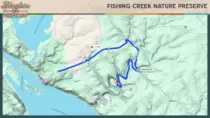
Fishing Creek Nature Preserve Trail Map. From Susquehannock State Park until I turned around right before the second ford.
I bought the Cruiser on a Tuesday and by Thursday night (January 30th, 2025) I was already trusting it with my dignity on an ice-covered goat path. That is the peculiar optimism of new-to-you ownership. The paint’s already got some swirls and scratches, so… Send it!
OnX showed just one trail within an hour of me, out by Holtwood. The turn-by-turn started in the serene Susquehannock State Park and dropped through paved hairpins to a gravel ribbon where Fishing Creek cuts the road 3 times on concrete slabs.
“Easy,” it said.
Like a public-access tutorial level with minimal consequences.
I left Lancaster after dinner at 8:45 and headed south.
Nine days before, on January 21, about six inches of white and fluffy dropped, from New Holland to East Petersburg, which means north-facing hollows kept their shine long after the salt trucks punched their timecards. By 8:53 pm on January 30 the air was a crisp 34 degrees, with light wind and a mostly clear sky. (WGAL, Weather Spark)
FJ, Meet Fishing Creek Nature Preserve
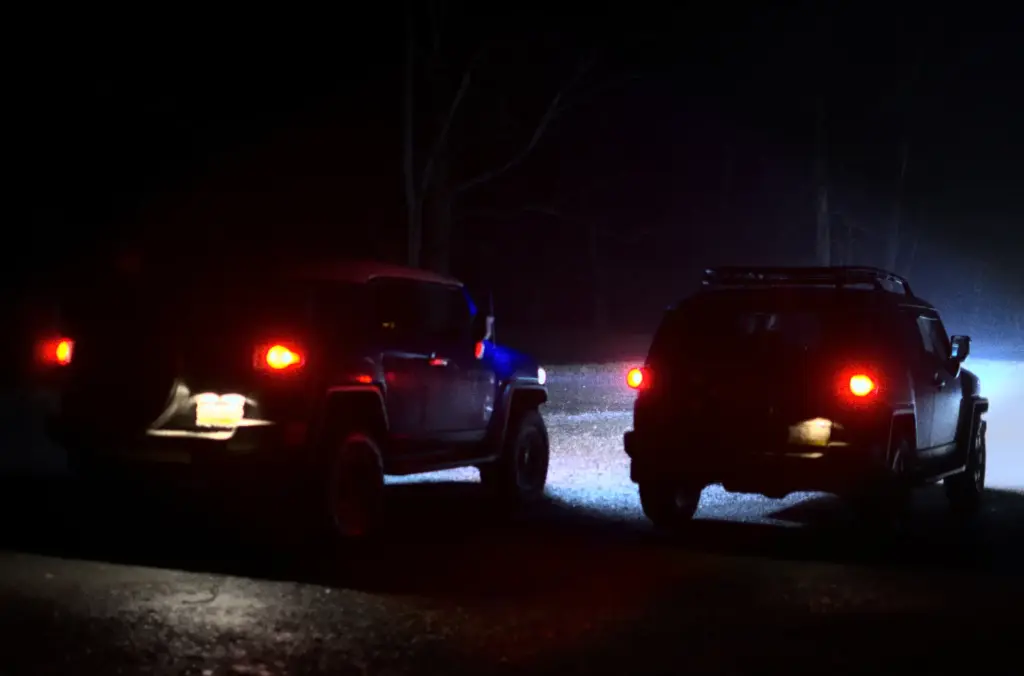
Stock Headlights at Fishing Creek Nature Preserve on a Moonless night
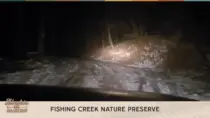
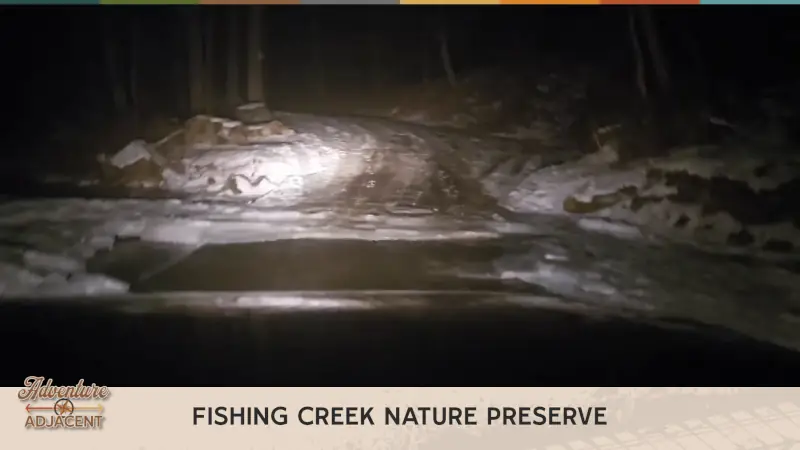
Out past the last porch light, the factory headlights might as well have been whale-oil lanterns. The weak, yellow beams reflected off a sign I’ve learned to love: No Winter Maintenance.
6 inches of snow through 9 days of partial melt, refreeze, and equally adventurous drivers and the trail became a hard packed, NHL-level practice spot.
Creek corridors hold cold longer than a scorned partner, which is exactly how you get a skating rink on a trail and a grin in the windshield’s reflection.
I got to the first ford and saw just how deep the hard pack had become. Three or four inches down into a quick moving stream, five or six inches back up. I dropped carefully but knew I’d need to carry a little speed to get back up the other side.
The trail beyond was slick, glossy, and narrow, lined with hemlock unseeable on the moonless night.
I tip-toed tensely to the second crossing but chose to keep both the truck and my reputation intact. The 72-point turn I executed would bore an audience, but it was the smart move when faced with rushing water alone in the winter with no signal.
Rhythm, not Volume
An icy incline illuminated by old, fogged headlights, just past the first ford.
Out here, adventure isn’t volume, it’s rhythm. The knob doesn’t need to be turned all the way to the right to get that thrill. A tune hummed below the breath while you do something dangerous, difficult, and rewarding.
Small inputs, simple lines, and the humility to reverse out before the story gets expensive.
If there is a creed in that, it’s ancient but practical: The journey of a thousand miles begins with a single step. On sketchy trails it begins with measured throttle tip-in and leads to decisions that get you home.
The Part Where We Act Like Grownups
The Lancaster Conservancy calls Fishing Creek a preserve, which is a diplomatic way of saying “behave yourself.” Treat the trail not like a toy you borrow, but a tool you own. Cut your teeth here but leave the braggadocio at home.
Live mindfully. Leave quietly. The trail should look the same through the windshield as it does in the rearview.
Final Thoughts
An icy incline illuminated by old, fogged headlights, just past the first ford.
What I learned, besides the limits of late-halogen-era lighting, is that capability only counts when it comes wrapped in judgment. I went in and came out a rookie with a gold star in good judgment.
It was a perfectly fine night. No trophy, no drama, just the first entry in the field notes.
When, Where, Conditions
When: Jan 30, 2025 from 8:30-10:30 pm near Lancaster, about 34°F, mostly clear, light wind. Shaded creek cuts stay icy even when air temps flirt with freezing.
Route: Public gravel road along Fishing Creek with three shallow fords on concrete slabs, wending away from Susquehannock State Park. Remote, narrow in places, easy when water is low. (onX Maps, Lancaster Conservancy)
Backdrop: Susquehannock State Park sits on a wooded plateau with river overlooks worth a daylight return. (Pennsylvania Government)
Stream note: Fishing Creek is designated high-quality cold-water habitat supporting wild trout. Tread lightly. (Lancaster Conservancy)
Recent snow: Jan 21 storm dropped roughly 5.5 to 6.3 inches around the county, which helps explain lingering ice.
Sky: Waxing crescent ~2% and already set by 7:17 pm, so moonless dark at go-time. (Time and Date)
Just before the drop into the rushing water on an icy moonless night.
How many creek crossings are on Fishing Creek?
Three. A public gravel road follows the stream through the preserve and fords it in three spots.
Is this road maintained in winter?
No. It’s a rural gravel road through a nature preserve and can be difficult in wet or winter weather. Always check conditions and travel prepared.
Help the wheels keep rolling by checking out the mods and gear I recommend!
As an Amazon Associate, we earn from qualifying purchases. We only recommend gear we use or trust—never paywalls, never pay-to-say-nice-things.