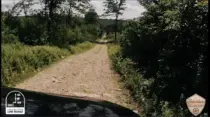
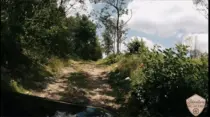
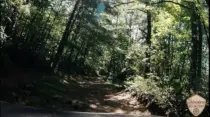
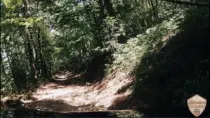
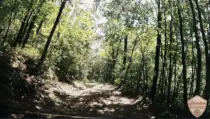
I’ve been head-down on work, projects, edits, and the usual life stuff. The cure I keep coming back to is simple: hop in the driver’s seat, pick a line, and share a quiet hour with good folks who like maps, miles, and learning by doing. So, live streams it is!
So, I’m adding live streaming to the mix.
It’s a low-friction way to hang out between big trail days and longer “Adventure” videos.
No rage, no gimmicks. Just calm runs, honest mistakes, and the small satisfactions that make this whole thing worth it.
Why Live Streams (and why now)?
Because the camera roll fills up faster than the edit queue.
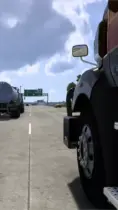
Streaming lets me unwind after work, keep the storytelling muscle warm, and bring you along even on the nights when the “trail” is a delivery route through Southern California in American Truck Simulator.
It’s also a place for questions, route geekery, and those nerdy detours about tires, logging roads, and how to not wad up your rig or your save file.
What I’m streaming
Driving sims: American Truck Simulator (ATS), Euro Truck Simulator 2 (ETS2)
Mud & mayhem: Expeditions: A MudRunner Game
Slow-build comfort games: Banished, Ostriv (and other city/civ builders)
Hunting season stuff: theHunter: Call of the Wild, Way of the Hunter, maybe even some Call of the Wild: The Angler
The vibe is relaxed.
We’ll talk lines, maps, and choices. If I bungle a trailer back-in or pick a bad approach angle, we’ll have a laugh and try again!
Adventure videos aren’t going anywhere
Field trips, gear tinkering, and longer “Adventure” videos will still show up here.
I’ll simulcast to Twitch and YouTube when possible.
No fixed schedule yet; for now it’ll be evenings and the occasional weekend session (Eastern Time).
Turn on notifications so you get the “we’re rolling” ping.
How you can help (free and fast)
Follow/Subscribe on Twitch and YouTube.
Say hi in chat. Lurkers welcome; questions even more so.
Share a stream with one friend who digs maps, trucks, or chill builder games.
Drop route ideas and mod suggestions in the comments. I’ll queue them up.
What to expect in chat
Kindness, curiosity, and problem-solving.
The point isn’t to be perfect; it’s to get a little better at reading terrain (digital or otherwise), make a few friends, and carry that calm to the next trail day.
See you out there, sometimes on gravel, sometimes on a virtual interstate, always trying to choose the better line.
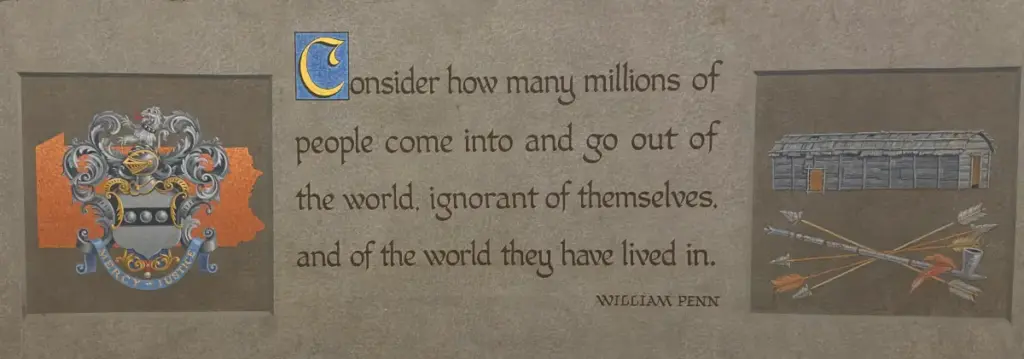
I took this photo at the State Museum of Pennsylvania back in February. It’s William Penn’s words:
“Consider how many millions of people come into and go out of the world, ignorant of themselves, and of the world they have lived in.”
It reads like a friendly nudge: “Hey, don’t miss the good stuff.”
I looked up the quote when I got home and in the very next lines of the same little book, Penn explained we’d never leave a grand palace without noticing the gardens and fountains; so why pass through life without noticing ourselves and our surroundings? (Quod Lib.)
He wasn’t scolding, he was reminding us to pay attention.
This journal entry is my small celebration of that idea.
You don’t need a plane ticket to widen your world. You don’t even need a full tank.
Just change your angle a few degrees and move a little slower.
Expand Your World… by Zooming in?
Years ago, I read a scene in Zen and the Art of Motorcycle Maintenance that I’ve never shaken.
A student is paralyzed by writing a five-hundred-word essay about the whole country.
Her teacher narrows the assignment: don’t start with the country, start with the town, no, the street. No! Start with one building! No, no, no! With a single brick. Better yet, the upper-left brick of the Opera House.
Suddenly the words come. Five thousand of them.
The problem wasn’t lack of content. It was too much distance and an overly broad perspective.
Many of us look at travel the same way. When we try to “see the world,” we freeze up under the weight of the entire globe.
Narrow your view.
Look at one curve of a creek, one street corner, one mossy log.
That’s your upper-left brick.
Hollow Highways vs Unprocessed Pavement
Interstates are marvels of engineering but terrible teachers.
They level the hills, straighten the curves, and pull service plazas over the landscape like fitted sheets (tidy but bland).
Highways are designed to remove friction. But the cookie cutter mile markers, interstate signs, and rest areas homogenize the otherwise unrefined and unprocessed localized scenery that tells you where you actually are and who lives there.
On highways, billboards and exit numbers change, but you don’t.
They shave time off the ETA, but the currency exchanged is exploration for that quick arrival.
Back roads give you rough edges to shape into core memories. A ranch house with a homemade patio. A planter made of old BF Goodrich tires.
Those tell you more about a place than any mile marker.
The color someone paints a door or the way they stack firewood reveals their priorities.
And when the surface turns rough, and we tiptoe in low range, the world swells with detail.
Mushrooms lace a downed maple. A roadside spring burbles out of a stone face. A hawk drops off a telephone pole and toward an open lake, re-emerging with a fish in its talons.
You didn’t know any of this was there, because you’re usually on pavement, half a mile away and pushing the upper bounds of the speed limit.
Moving slowly isn’t just safer for tires and oil pans. It’s training for mindful seeing.
Penn was a Quaker, the founder of Pennsylvania, and he tried to build a place where ordinary people could live with unusual freedoms for the time: religious tolerance, representative government, and a very public experiment in getting along.
He called it a “holy experiment,” and his Frame of Government sketched out ideas that echoed far beyond his colony. (Encyclopedia Britannica)
Quakers prized plain speech, saying things directly, without fancy words.
And they famously used “thee” and “thou” long after those pronouns fell out of everyday English. It was their commitment to treat everyone equally.
That habit of directness and equality shaped the culture that grew here. (Quaker.org)
So, when Penn writes “ignorant,” he isn’t sneering.
In his Fruits of Solitude, the passage continues: “if we’d never tour Windsor Castle without noticing the gardens and fountains, why do so many people pass through life without noticing their own bodies, minds, and the world they’re in?”
It’s a lament for missed wonder.
Expand Your World, on a budget
Booked tickets and stamped passports aren’t a requirement when you can discover the world for less than the cost of lunch.
Pick a square mile you think you know. A park you drive by all the time but haven’t visited, the neighborhood behind your grocery store, wherever. Give yourself an hour to walk it like a tourist. Read every little sign. Try to notice which trees were planted and which came from the magic of nature. Count how many kinds of mailboxes you see.
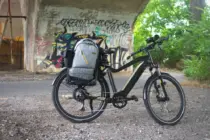
Ride a bike where you usually drive. The slope you never noticed in a car becomes a hill with personality. The smell of fresh baked bread wafts from the deli you’ve blurred past since 2012.
Trade one route a week for the long way. Stop at the farm stand you always promise you’ll stop at “next time” and ask the person behind the counter what’s growing weirdly well this year.
Go mushroom watching. (Unless you already know mushrooms, don’t eat anything, please.) Collect them with your camera or a notebook. You’ll start to see patterns where each variety lives, on a stump, a fallen log, in disturbed soil, at the foot of oaks.
Borrow the old county atlas from your library and trace one thin gray line that you’ve never taken. Chances are it follows a creek, and creeks are always worth your time.
The trick isn’t distance, it’s attention.
What the FJ keeps teaching me
My FJ is happiest in 35 zones and on forest roads. Slow going rewards you with exactly the small, clear truths Penn and Pirsig pointed toward.
The truck’s whole personality is an argument for patience: choose a line, roll on the throttle, feel the tires communicate.
You can hear different birds with the windows down at five miles an hour than you ever catch at fifty-five.
The biggest thing I’ve realized is:
I didn’t need the truck to make me see the world differently.
The world is there whether I’m in the seat of a Land Rover, Jeep, Toyota, or Schwinn.
The FJ is fun, I plan to keep it around as long as possible, but, in hindsight, I didn’t really need this to get out and go slow.
You might enjoy your purchases, but curiosity outlasts gear.
See More. Get More.
Slow travel pays off in human details too.
Highways connect cities. Back roads connect porches.
If you want to understand how people actually live, pay attention to their small choices around their homes.
When you see a Little Free Library topped with a tin rooster, you’re seeing affection expressed in wood screws and weatherproof paint.
When you find the neighborhood where every stoop has a bucket of sidewalk chalk, you can bet those blocks hum with scooters and laughter after the last school bell.
The more we see of the human condition (the real ways people solve small problems, decorate their homes, and protect their peace) the broader our understanding of people’s everyday realities becomes.
It shows us that the “other side of town” is mostly just “our side of town” with different snacks and, maybe, a better porch swing.
Micro-pilgrimages
I’ve come to think of these little outings as micro-pilgrimages.
It’s not about praying or religion though. They don’t require sacred sites; they require sacred attention.
Drive to the State Museum, stand in front of a quote, bask in it once, twice, a dozen times until it lands.
Walk the same loop you always walk but carry a notebook this time and sketch the shape of one leaf you can’t name.
Visit a historic marker you’ve ignored because it sits in a strange spot next to a tire shop. Then read the details linked to that marker and let the past sit with you for a minute.
Penn’s “holy experiment” didn’t become a museum caption overnight; it was written in real time by friends and strangers arguing about how to live. (Encyclopedia of Greater Philadelphia)
If you want to add a pinch of structure, borrow a tool from Pirsig’s teacher: give yourself one ridiculously narrow prompt each time you go out:
Photograph only mailboxes today.
Write one paragraph about the way water moves on the trail after last night’s rain.
Find three colors of lichen.
Learn about lichen’s role in the local ecosystem
Focusing on the “upper-left brick” has a way of opening the entire wall. (Terebess)
A quick nod to the past that made this present
Penn’s experiment wasn’t perfect. No experiment run by actual humans is.
But the ideas he pressed into the foundation here still matter.
He imagined a place where people of different beliefs could live together, and he built a government that tried, in its imperfect, 17th-century way, to support that.
Those principles of religious tolerance and representative rule influenced the place we live now.
And the way he and his fellow Friends valued plain speech still reads as an amiable challenge: say true things simply, then go act like you mean them.
That, too, is a way of paying attention. (Western Friend)
Tips to Expand Your World
Set a 90-minute timer. Pick one. Do it.
Pick one back road you’ve never taken between two places you already go. Leave ten minutes early. Expect to stop once and just…look.
Visit one small museum within an hour of home. Find a single artifact or plaque that makes you curious, then look up the source later. Primary sources are a rabbit hole worth falling into.
Walk a trail at half-speed. Count how many different plants are growing on a single dead log. You will be astonished.
Talk to one person about the thing they maintain. A garden. A block. A food pantry shelf. Ask what they’ve learned and pay attention to the answer.
None of this requires money, gadgets, or influencer cred.
It requires a willingness to move your eyes and your feet a little differently.
The Happy Conclusion
Penn’s line is an invitation. Most of us won’t circumnavigate anything. And that’s fine. You can expand your world right where you live.
Start with a brick: the corner of a city block, the rough bark of a neighborhood oak, the cinder-block wall behind a diner where a downspout broke and rain has washed the paint thin.
When you slow down, the world shows off. And when you really see, you carry that attention to the next place, and the next conversation, and the next problem that needs a patient human.
I’ll keep taking the long way home. Trips are always more fun with friends. Come along.
Help the wheels keep rolling, and show your love of affordable adventure with clothing designed by yours truly!
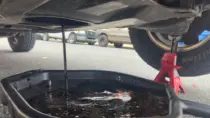
Two months, 5,000 worry-free miles, time for the first FJ Cruiser oil change. Warm it up, drop the plug, swap the filter, fresh crush washer; nothing that earns a merit badge.
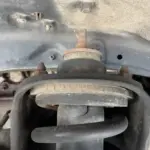
The only surprises were the honest ones: two torn inner CV boots and the reminder that trucks tell the truth long before the sales brochures.
FJ Cruiser Oil Change: Kneeling at the 5,000 Mile Altar
The drain stream looked like strong coffee and the filter surrendered like it had somewhere else to be. Top up with fresh 5W‑30, check for leaks, done.
Somewhere between the drain plug and the dipstick I spotted CV grease flung like confetti.
Add it to the list, but the next few Saturdays are spoken for.
Old trucks are simple that way: feed them boring maintenance and they repay you with more interesting miles than you have any right to.
What oil weight?
Toyota recommends SAE 5W-30 for the 1GR-FE
Five Quarts and a Quiet History Lesson
It’s good yet.
As I lay there on my back, staring at the Cruiser’s underbelly, the grease, oil, and hot engine smells brought me back.
I grew up behind GM parts counters; my dad worked for GM for 20+ years during the now infamous “malaise era.” The Buy American chorus trumpeted from every terrestrial radio station and between every prime-time TV show.
I knew bone deep: trucks with bow-tie emblems were the best.
Later I learned those opinions ship with hidden dealer costs: a tariff with a barnyard nickname pecking at truck choices since the ’60s, “voluntary” limits on car imports from Japan in the ’80s, and ad men who deftly disguised consumerism as patriotism.
None of it is scandal; it’s stagecraft. You’re just part of the planned suburban furniture until you bring a different rig to the show.
The FJ is that different rig. It doesn’t argue. It just starts, shrugs at mileage, and behaves with better manners than man’s best friend… sorry, Hugo.
How much oil do I need for my FJ Cruiser oil change?
Have 6 quarts on the bench; you’ll use about 5.5 quarts with a new filter.
Slogans sell trucks. Loyalty is earned in miles, not marketing.
What the FJ Cruiser Oil Change Actually Told Me
Nope, not good.
Post‑oil change crawl around: bushings with tasteful crow’s‑feet, hardware where Toyota left it, CV boots officially on the to‑do list.
The message was simple: keep up the mundane maintenance and I’ll handle the adventurous bits. Fair trade.
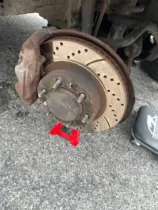
One curiosity from the crawl around: the previous owner fitted drilled and slotted rotors up front. They stop fine, but they’re not my forever plan.
That rant gets its own post; for now, call them temporary tattoos on the front hubs.
From 0-60 to 4-Low
I used to memorize 0-60 times and horsepower numbers. I drooled over Motown metal from the 50’s and 60’s and imagined building my own sleeper project.
These days I prefer the quiet satisfaction of picking a line, letting the truck do its clever little traction trick, and showing up for Monday morning school drop-off like nothing happened.
The FJ excels at that kind of competence. It asks for oil on schedule and patience for aging rubber. In return, reliability becomes a personality trait.
How tight should I make the lugs after rotating the tires?
Toyota recommends 85 ft-lb or 113 N-m
Why Toyota?
No conversion therapy, no celeb-studded ad campaign. Just a machine that rewards attention.
If there’s a moral, it’s this: maintain the truck you have, doubt the stories you inherited, and let experience pick your team. The rest is shop towels, torque specs, and flashing MAINT REQD lights.
Be Part of the Conversation
If you defected from one badge to another, tell me what converted you. Or share what runs through your mind while you’re turning wrenches.
Until next time, I’ll be under the truck plotting a CV reboot and pretending drilled rotors add horsepower.
Spin-on Toyota 99015-YZZD3 [*Affiliate Link] (OE).
Maintenance reminder reset
Odometer showing -> key to ACC/LOCK – hold trip reset -> key to ON while holding -> bars count down to “000000” -> release; light goes off.
Wheel lug nut torque
85 ft-lb (113 N-m) (handy if you rotate tires).
TRD front skid-plate bolts
22 ft-lb (30 N-m) (if you have one of those)
*If you click a link on this page and make a purchase, we may earn a commission. As an Amazon Associate, we earn from qualifying purchases. We only recommend gear we use or trust—never paywalls, never pay-to-say-nice-things.
Step-by-Step
Warm it up. Three to five minutes brings the oil from maple syrup to pour-over. Shut it down.
Open the stage. Drop the little service door or the front skid (Mine doesn’t have the service door) if you want elbow room (re-torque to spec on the way back).
Catch ready. Pan under the plug; crack the 14 mm drain bolt and let it ride. Admire the coffee-dark honesty.
Filter off. Spin the old filter free. If it’s stubborn, clean the base and use a proper cap wrench.
New gasket, not new muscles. Oil the new filter’s gasket, spin on hand-tight plus ¾ turn.
New crush washer. Refit the drain plug with a fresh washer; torque to 30 ft-lb (40 N·m).
Fill. Add ~5.5 qt (5.2 L) of 5W-30, cap on, and fire it up.
Leak check. Idle 30–60 seconds, peek under—dry is the right answer.
Level set. Shut down, wait a couple minutes, dipstick check, top off as needed. (The manual says ~1.6 qt between “low” and “full.”)
Reset MAINT REQD. With the odometer showing, key to ACC/LOCK → press & hold trip → key to ON while holding → bars count down to 000000 → release. Light out.
Bonus 5K scan. Quick look at pads/rotors, belts, ball joints/dust covers, CV boots (mine scared me), and fluids. Rotate tires and hit the prop-shaft grease.
Recycle. Used oil and filters go to a parts store or municipal drop-off. Ducks everywhere thank you.
A Note on Safety & Sanity
I’m sharing what I do on my own truck. Use your judgment, follow your service manual, torque to spec, recycle your oil, and know your limits. If something feels sketchy, get a pro.
Berry Mountain – Weiser State Forest — Greenland Tract, Central Pennsylvania Date/Time on Trail: July 22, 2025, roughly 2–4 p.m.
I pointed the FJ at the spine of Berry Mountain and did the slow climb that my task list keeps trying to talk me out of.
The ridge runs above the Wiconisco Valley, a long, stony shrug of earth with rattlers, a few steep pitches, and the kind of views that make you forget about the rat race.
I wasn’t blazing new trails. I was spending quality time with the kids and learning a lesson in forest management. My gear list doesn’t need to expand as much as my mind does.
A short way into the mostly groomed gravel forest road a deer gave us a few frames of natural beauty before disappearing into the foliage. White tail on full display as she bounded back into the thickets. It was a good reminder that in working forests, we’re loud guests on four tires.
Where We Are: Berry Mountain
Berry Mountain sits in the Weiser State Forest’s Greenland Tract, in the northeast of Dauphin County, with access via Radar Road and Berry Mountain Road. Those are the two names you’ll see on DCNR maps and campsite listings for this tract.
It’s classic ridge-and-valley country: rocky, narrow in spots, and worth every careful foot of elevation you earn.
If you’re used to State Parks, which are all manicured and laden with trail markers, state forests might surprise you. These are working woods under the Pennsylvania Department of Conservation and Natural Resources (DCNR).
They’re managed for many things at once: clean water, habitat, timber, and places like this where you and I crawl along a ridge in low gear for no reason that makes sense on paper.
A Forest with Two Seals
Pennsylvania’s 2.2-million-acre state forest system is dual certified. Audited to both FSC (Forest Stewardship Council) and SFI (Sustainable Forestry Initiative) standards.
That’s not a PR line; it means outside experts look at how these forests are managed and publish their findings.
FSC emphasizes things like independent audits and chain-of-custody. That meanstracking wood from forest to mill to product.
SFI leans heavily on on-the-ground safeguards like water quality, biodiversity, and conservation values.
Pennsylvania carries both seals, and Weiser is part of that system.
In plain language: when you see a timber sale in a state forest, it’s not a free-for-all. There are plans, buffers, and oversight. And if an audit finds gaps, corrective actions follow.
The Commonwealth’s publicly posted 2024 audit summaries exist for exactly this reason: so the public can check the checker.
I think about that when I pass a culvert that’s actually built right, or when a trail stays a trail and doesn’t dissolve into a trench.
Someone planned, paid for, and inspected that. That’s what dual certification is purchasing for us.
Berry Mountain: The Name on the Map
This state forest is named for Conrad Weiser, and if you grew up anywhere near Berks or Dauphin County, his name is on signs you’ve driven past a hundred times.
Weiser was an 18th-century German immigrant who served as an interpreter and diplomatic go-between during decades when Pennsylvania’s future was being negotiated, sometimes literally, in council houses and courtrooms.
The PHMC (Pennsylvania Historical & Museum Commission) and DCNR both summarize him the same way: a bridge-builder who helped shape Pennsylvania’s Indian policy.
As a teenager, Weiser spent the winter of 1712–1713 among the Mohawk tribe, learning language, protocol, and the careful cadence of council. Skills that made him indispensable later.
By the 1720s he’d settled near present-day Womelsdorf in the Tulpehocken Valley. You can still visit the Conrad Weiser Homestead to get a sense of his home ground.
If you’ve heard of the Treaty of Lancaster (1744), you’ve seen Weiser’s name in the minutes as interpreter—standing at the hinge between colonial officials and Haudenosaunee leaders.
The minutes read like a slow-burn play: greetings, speeches heavy with metaphor, long pauses, and the crucial work of getting words right so war doesn’t start by accident.
It’s fitting that an entire state forest bears the name of someone whose primary tool was listening.
The Ridge, Today
My window for this ride was a hot Tuesday afternoon, July 22, 2025.
I did what you do here: I aired down modestly, eased into the grades, and picked lines that prioritized traction and sight lines over drama.
Ridge roads are honest: they don’t reward speed so much as careful thought.
The FJ, 18 years into its tour of duty, did what old tools do: worked without fanfare and reminded me that confidence at five miles an hour beats panic at fifteen.
There’s more than one section on this trail that tilts you left or right at an angle that has you make eye contact with your passengers. Today, those passengers were my kids, so I played that “Dad has this one” smile in the rearview.
Then after we leveled out, I said “Phew, were you as nervous as I was back there?!”
Stewardship, On Purpose
This forest feels like it’s being cared for, because it is.
I don’t love everything the DCNR does, but their model is pragmatic: harvest where it makes sense, protect where it matters, and keep the whole system healthy enough to handle droughts, pests, and people like us who believe a good day can be measured by dust and engaged lockers.
Pennsylvania emphasizes exactly those values in its materials, and the dual-certification framework is one of the ways the Bureau of Forestry holds itself to them.
It’s not perfect, nothing involving budgets and humans is, but transparency and third-party oversight beat hand-waving.
That brings me to the uncomfortable part: these roads, gates, bridges, culverts, maps, and audits don’t fund themselves.
We already know this, but it’s worth saying out loud. If we use the forest, we owe the forest. Sometimes that’s a purchase: a permit, a donation to a local conservancy, buying certified wood because it helps keep this entire accountability apparatus solvent. Sometimes it’s time: volunteering on a trail day, packing out more than you brought in, or writing a polite email when you see a washed-out section that needs attention instead of foraging your own bypass.
The grand old idea, that public goods are actually good and belong to the public, starts on days like this, on ridge roads with deer that won’t pick a lane.
A Thin Thread to the Past
Driving Berry Mountain with co-signed by Conrad Weiser, it’s hard not to think about translation:
Weiser translated words; the DCNR translates policy into lanes that hold after a storm.
The audits translate promises into documented outcomes.
The dual-certified labels are a kind of translation for the rest of us: proof that somebody checked the math.
The fact that we can move through this landscape, quietly, slowly, imperfectly, owes a lot to people whose work you don’t notice when it’s done right.
I didn’t see another truck for most of the afternoon. Just the deer, some birds singing their sultry songs, and a blue sky dotted with fluffy white clouds.
I took a last look at the valley as we climbed back from our turn around mid-way through the tough stuff and rolled back down the ridge, trying to make as little noise as an old off-road truck can make.
If You Go
Location: Berry Mountain, Weiser State Forest Greenland Tract (access via Radar Road and Berry Mountain Road). Check DCNR maps before you go; access can be variable by season and condition.
Land Manager: Pennsylvania DCNR Bureau of Forestry — part of the 2.2-million-acre, FSC + SFI dual-certified state forest system.
Good Steward Tips: Tread Lightly principles:
Stay on designated roads
Respect seasonal closures
Pack it out
Consider donating to local stewardship groups
History Stops: Conrad Weiser Homestead (Womelsdorf) for context and perspective before or after your ride. It’s hard to be careless in the woods after you’ve spent an hour with the story of a man who built peace out of paragraphs.
Sources & Further Reading
Weiser State Forest overview and dual-certification note (2.2M acres; FSC + SFI). Pennsylvania Government
Greenland Tract map and Weiser maps index; access via Radar Road / Berry Mountain Road reflected in campsite directions.
If I thought I was going to die tomorrow, I should plant a tree, nevertheless to-day.
Stephen Girard
Who Was Stephen Girard?
Girard is a Pennsylvania-sized paradox.
He stayed in Philadelphia during the 1793 yellow fever outbreak and helped run the Bush Hill hospital with Peter Helm. (Clio, Hidden City Philadelphia)
Direct action before the term existed. No committee, just work that needed doing.
Thousands died, but the place functioned because neighbors chose duty over comfort.
Two decades later he did something only a handful of humans could do.
He underwrote as much as 95 percent of a crucial federal loan when U.S. credit collapsed during the War of 1812. (Encyclopedia Britannica, Girard College)
If you ever wondered whether one person can change the arc of a story, there is your answer in ledgers and loan payments.
Trader. Slaver.
Girard slave pens, Louisiana, 1894. Exterior of stone holding cells linked to Philadelphia financier Stephen Girard. Photograph by W. N. Jennings. Courtesy of the Library Company of Philadelphia.
But his story isn’t clean.
Girard’s fortune was built inside systems that exploited people. He owned enslaved people in Pennsylvania and Louisiana. The Library Company preserves an 1894 photograph labeled ‘Girard Slave Pens’ from a Louisiana property. (Teachers Institute of Philadelphia, Library Company of Philadelphia)
Grim architecture that outlived him.
Legacies are forests. Some trees give shade. Many grew from poisoned soil.
His will created Girard College. That’s a residential school endowed for “poor, white, male orphans”; desegregated in 1968 after prolonged legal fights; girls admitted in 1984.
It took years of organizing and multiple court battles before the color line fell, and girls were admitted much later. (National Archives, Girard College)
A public gift with locks on the door that Philadelphians spent generations battering down.
Where Do We Go From Here?
So… what do we do with a legacy like that?
Off-roaders inherit our own contradictions.
We love wild places. We also drive to them.
We celebrate freedom, then post a trail that cannot survive fame.
The answer isn’t guilt. It’s responsibility. Horizontal habits don’t need committees.
Stewardship in Practice
Consent and care are key.
Pack a spare trash bag and a shovel because strangers will need both. Bury what needs burying the right way or pack it out.
If a gate is closed, the conversation ends. The commons is only common if we act like we share it.
Invest in collective capabilities. Teach a friend to air down and air up. Show your kid how to spot a line without shouting. Lend the cross wrench and show them how it’s done.
The point of competence is not superiority. It is liberation for the next person who learns it.
Define Your Dash
Family history folks have a phrase I love: “Define your dash.” (FamilySearch)
Everything between the dates is yours to write, and the time between is so much more limited than we can possibly realize.
Maybe your dash will never buy a bank or endow a school. Good.
You have Tuesday nights in the garage and parking lots where somebody needs a jump.
You have small creeks that need one more bag of trash packed out.
You have a voice at the land use meeting when a place you love risks being priced, paved, or parceled out of public use.
Spreadsheets Can’t Define Your Dash
If tomorrow were your last, plant something today.
A sapling in your yard. A habit in your crew. A path of least damage across a wet section you could have chopped to pieces.
History says legacies are mixed, even for people with statues. Our job is to stack the deck.
Leave more shade than exhaust.
Leave more skills than stories.
Leave places and people better than we found them. That’s how we define our dash and earn whatever future parks its wheels in our ruts.
Trail Code
Air down before dirt; skip waterlogged segments that will rut the trail.
Yield to uphill traffic; keep speeds down near camps and overlooks.
Pack out more than you packed in; bring a contractor bag on every trip.
No geotags for fragile spots; share locations responsibly, person-to-person.
Camp on durable ground; kill generators at quiet hours.
Volunteer days > hot takes; sign up for a trail workday each season.
Help the wheels keep rolling, and show your love of affordable adventure with clothing designed by yours truly!
I’ve got a full Adventure Log and a long video coming this week from Berry Mountain featuring rocky climbs, sketchy pitches, and a deer who seemed miffed at my existence.
Today’s just the teaser and the promise: the story lands with the video.
Route stats and map are prepped; lessons learned are already scribbled in the margins.
If you like old-truck competence and roads that turn into rumors, you’ll want to be here for it.
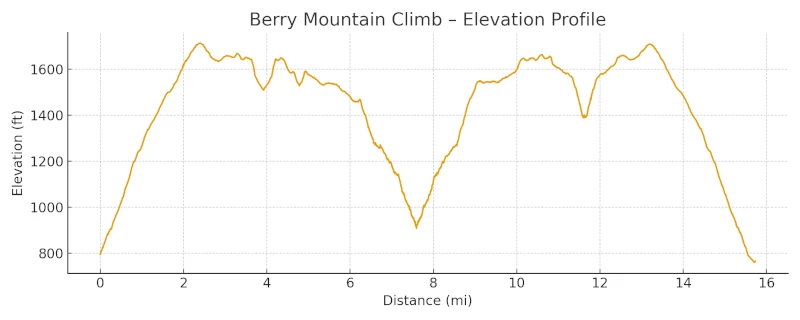
What to expect from the Berry Mountain Climb video:
Distance: 15.7 miles
Elevation gain/loss: 2,032 ft / 2,120 ft
High/Low elevations: 1,713 ft / 760 ft
Total Time (Not the video length): 2 hours, 2 minutes, 13 seconds
Average speed: 7.7 mph
Max grade: ~14.4% (approximate)
Help the wheels keep rolling, and show your love of affordable adventure with a sticker designed by yours truly!
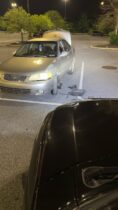
She limped into the lot in a tired gold Sentra, front tire punching its timecard early, leaving the bead to give the bumper a kiss goodnight.
The humid summer night smelled like hot ATF and regret.
I swung the Cruiser around. Window down: “Need a hand?”
She nodded, grateful, the way people are when they expected the world to look away and it didn’t. She shuffled toward McDonald’s to sit while I popped her trunk and got to work.
It Wasn’t a Trail, But It Was Still a Recovery
This is why I carry gear. Not for a reel. Not for the someday trail heroics. For nights like this, under buzzing parking light lots, with a stranger who just wants to get home.
Spare was intact. Jack present. No lug wrench, which is why a cross wrench lives in my rig.
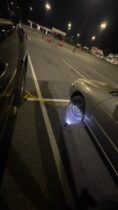
Her scissor jack wanted the factory tool to spin it, so I used a 13/16 socket and my Makita.
Lugs loose. Wheel off. Donut on.
The compressor hummed and the little tire swelled like a bee sting before antihistamine.
No drama. No mud. Just a quiet win between a cart corral and the smell of fries.
I closed her trunk and handed back the keys, and the thought that wouldn’t leave me alone was this:
Capability matters because it converts to care.
Tools are cool. Mutual aid is cooler.
The Part With More Opinions Than Lug Nuts
We’re taught to outsource everything. Dial the auto club, wait for a truck, stand by the phone.
That’s tidy for a spreadsheet, but it breeds helplessness in the wild where you actually live.
A neighborhood used to be a warranty. Now it’s a parking app and a service tier.
I’m not anti-Triple A. Been a member for as long as I could drive.
I am pro-you, pro-me, pro-we-keep-us-safe.
Ten minutes with a cross wrench beats an hour on hold.
The supply chain is you, with a headlamp and a socket set.
The safety net is us, showing up without asking for permission or giving a customer number (“Which of these 18 digits did you need again?”).
The luxury isn’t leather. It’s competence and enough kindness to share it.
The TLDR:
Your gear should be used. The compressor, cross wrench, and headlamp are not decor. They’re tickets to being useful on ordinary nights.
Skills are a commons. Change one tire and you can teach three people. That is how capacity multiplies.
Check your spare. Spares seep air in the dark. Read the pressure printed on the sidewall and keep it there. A flat spare is dead weight.
Small aid is still aid. You will not fix the world from a parking lot. But you can fix someone else’s day, week, or month.
How To Change A Tire Safely
If you came for the steps, here’s the no-drama version of how to change a tire.
Get safe and seen. Pull out of traffic. Hazards on. Parking brake set. If you have them, toss a couple of wheel chocks or beefy rocks behind the tires that stay on the ground.
Find the jack point. Check the owner’s manual or look for reinforced pinch welds or frame pads near the flat. Avoid soft bodywork.
Crack the lug nuts first. Before lifting, loosen each lug a quarter turn in a star pattern. You want the tire on the ground for leverage.
Lift the vehicle. Position the jack on the correct point and raise the tire just off the pavement.
Remove the wheel. Take the lugs the rest of the way off, keep them somewhere clean, and pull the wheel straight toward you.
Mount the spare. Line up the holes, slide it on, and spin the lugs on finger tight in a star pattern.
Lower and snug. Bring the vehicle back to the ground. Tighten the lugs in a star pattern until they are good and firm. Use a torque wrench if you have one and the spec from the manual.
Air it. Inflate the spare to the pressure written on its sidewall, or the pressure on the driver’s door jamb sticker. If it’s a compact spare, follow the speed and distance limits printed on it. No exceptions for good or bad behavior.
Stow and recheck. Tools away, flat in the trunk, recheck lug tightness after a few miles.
Safety note: A jack lifts. It does not support. Never crawl under a car supported only by a jack. Especially the cheap junk most manufacturers include.
After a little resuscitation, the spare is awake
How to Change a Tire: What You Should Have
Cross lug wrench.
Compact compressor.
Tire plug kit.
A jack you trust (bottle or low-profile floor jack if you have space).
Headlamp or work light.
Gloves and a kneeling pad.
Wheel chocks.
A spare with the correct pressure printed on its sidewall.
The Quiet Point
Adventure Adjacent isn’t just trails and pretty vistas. It’s the tiny civic moments where capability turns into kindness.
Check your gear. Check your spare. And when someone limps into a parking lot at 10 pm, be the person who stops.
Help the wheels keep rolling, and show your love of affordable adventure with clothing designed by yours truly!
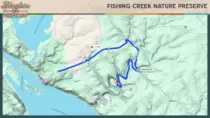
Fishing Creek Nature Preserve Trail Map. From Susquehannock State Park until I turned around right before the second ford.
I bought the Cruiser on a Tuesday and by Thursday night (January 30th, 2025) I was already trusting it with my dignity on an ice-covered goat path. That is the peculiar optimism of new-to-you ownership. The paint’s already got some swirls and scratches, so… Send it!
OnX showed just one trail within an hour of me, out by Holtwood. The turn-by-turn started in the serene Susquehannock State Park and dropped through paved hairpins to a gravel ribbon where Fishing Creek cuts the road 3 times on concrete slabs.
“Easy,” it said.
Like a public-access tutorial level with minimal consequences.
I left Lancaster after dinner at 8:45 and headed south.
Nine days before, on January 21, about six inches of white and fluffy dropped, from New Holland to East Petersburg, which means north-facing hollows kept their shine long after the salt trucks punched their timecards. By 8:53 pm on January 30 the air was a crisp 34 degrees, with light wind and a mostly clear sky. (WGAL, Weather Spark)
FJ, Meet Fishing Creek Nature Preserve
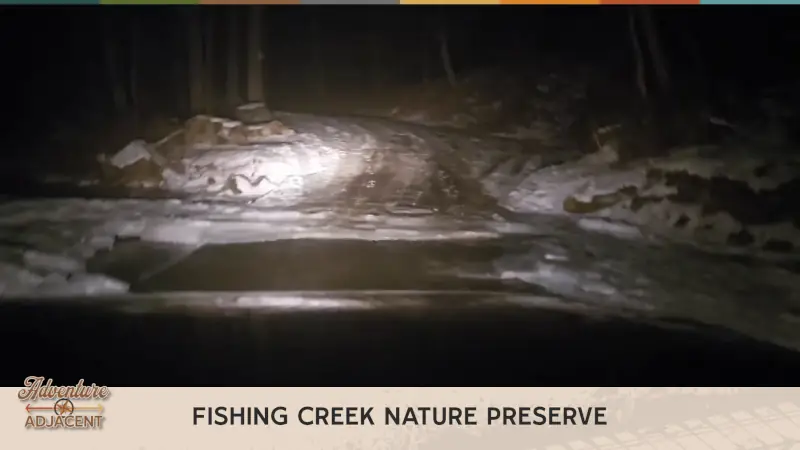
Stock Headlights at Fishing Creek Nature Preserve on a Moonless night
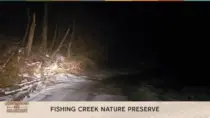
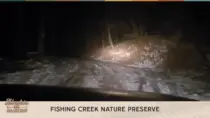
Out past the last porch light, the factory headlights might as well have been whale-oil lanterns. The weak, yellow beams reflected off a sign I’ve learned to love: No Winter Maintenance.
6 inches of snow through 9 days of partial melt, refreeze, and equally adventurous drivers and the trail became a hard packed, NHL-level practice spot.
Creek corridors hold cold longer than a scorned partner, which is exactly how you get a skating rink on a trail and a grin in the windshield’s reflection.
I got to the first ford and saw just how deep the hard pack had become. Three or four inches down into a quick moving stream, five or six inches back up. I dropped carefully but knew I’d need to carry a little speed to get back up the other side.
The trail beyond was slick, glossy, and narrow, lined with hemlock unseeable on the moonless night.
I tip-toed tensely to the second crossing but chose to keep both the truck and my reputation intact. The 72-point turn I executed would bore an audience, but it was the smart move when faced with rushing water alone in the winter with no signal.
Rhythm, not Volume
An icy incline illuminated by old, fogged headlights, just past the first ford.
Out here, adventure isn’t volume, it’s rhythm. The knob doesn’t need to be turned all the way to the right to get that thrill. A tune hummed below the breath while you do something dangerous, difficult, and rewarding.
Small inputs, simple lines, and the humility to reverse out before the story gets expensive.
If there is a creed in that, it’s ancient but practical: The journey of a thousand miles begins with a single step. On sketchy trails it begins with measured throttle tip-in and leads to decisions that get you home.
The Part Where We Act Like Grownups
The Lancaster Conservancy calls Fishing Creek a preserve, which is a diplomatic way of saying “behave yourself.” Treat the trail not like a toy you borrow, but a tool you own. Cut your teeth here but leave the braggadocio at home.
Live mindfully. Leave quietly. The trail should look the same through the windshield as it does in the rearview.
Final Thoughts
An icy incline illuminated by old, fogged headlights, just past the first ford.
What I learned, besides the limits of late-halogen-era lighting, is that capability only counts when it comes wrapped in judgment. I went in and came out a rookie with a gold star in good judgment.
It was a perfectly fine night. No trophy, no drama, just the first entry in the field notes.
When, Where, Conditions
When: Jan 30, 2025 from 8:30-10:30 pm near Lancaster, about 34°F, mostly clear, light wind. Shaded creek cuts stay icy even when air temps flirt with freezing.
Route: Public gravel road along Fishing Creek with three shallow fords on concrete slabs, wending away from Susquehannock State Park. Remote, narrow in places, easy when water is low. (onX Maps, Lancaster Conservancy)
Backdrop: Susquehannock State Park sits on a wooded plateau with river overlooks worth a daylight return. (Pennsylvania Government)
Stream note: Fishing Creek is designated high-quality cold-water habitat supporting wild trout. Tread lightly. (Lancaster Conservancy)
Recent snow: Jan 21 storm dropped roughly 5.5 to 6.3 inches around the county, which helps explain lingering ice.
Sky: Waxing crescent ~2% and already set by 7:17 pm, so moonless dark at go-time. (Time and Date)
Just before the drop into the rushing water on an icy moonless night.
How many creek crossings are on Fishing Creek?
Three. A public gravel road follows the stream through the preserve and fords it in three spots.
Is this road maintained in winter?
No. It’s a rural gravel road through a nature preserve and can be difficult in wet or winter weather. Always check conditions and travel prepared.
Help the wheels keep rolling by checking out the mods and gear I recommend!
As an Amazon Associate, we earn from qualifying purchases. We only recommend gear we use or trust—never paywalls, never pay-to-say-nice-things.